
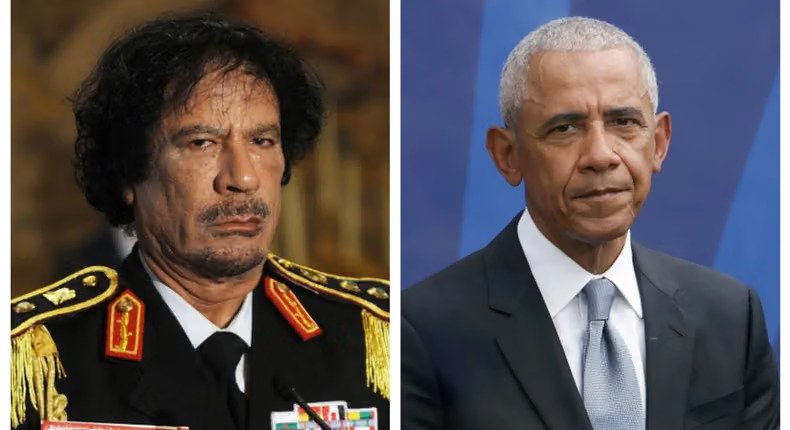
Fifteen years after NATO helped topple Gaddafi, North Africa’s military powers appear to have drawn a lasting lesson from Libya’s collapse, spending more than $320 billion to strengthen their armed forces, acquire advanced weapons and deepen alliances so they are not left as vulnerable in a future crisis.
In 2016, US President Barack Obama was asked to identify the biggest mistake of his presidency. His answer focused on Libya, where a NATO-led intervention had helped end Muammar Gaddafi’s 42-year rule five years earlier.
In an interview with Fox News, Obama described his “worst mistake” as “probably failing to plan for the day after what I think was the right thing to do in intervening in Libya.”
He nevertheless defended the intervention, arguing that it “prevented large-scale civilian casualties and prevented what almost surely would have been a prolonged and bloody civil conflict.”
Obama also acknowledged failures in managing the aftermath, conceding that there was “room for criticism” over the international follow-up.
Although he defended the military operation, he ultimately acknowledged the outcome.
“And despite all this, Libya is a mess,” Obama said.
Fifteen years after Gaddafi’s fall, Libya remains divided, while North Africa has entered a far more militarised era.
North Africa Is No Longer the Same
Since 2011, the region’s major powers have invested heavily in modernising their armed forces, including advanced fighter jets, attack helicopters, drones, air-defence systems, missiles and warships.
Algeria and Morocco, in particular, have become the leading importers of major conventional weapons in North Africa, while Egypt has also undertaken a major military-modernisation programme.
Together, the region’s major powers now possess stealth fighter jets, Rafales and F-16s, Apache attack helicopters, advanced air-defence systems, drones, missiles and modern naval platforms.
Between 2011 and 2025, Algeria, Morocco, Tunisia and Egypt spent more than $320 billion on their armed forces, according to calculations based on SIPRI data.
This military build-up took place amid growing regional insecurity, with instability spreading from Libya to the Sahel, Sudan and the Middle East, while North Africa’s leading powers forged different security alliances to strengthen their positions.
However, this spending cannot be attributed to Libya alone. The Algerian-Moroccan rivalry over Western Sahara predates the 2011 war, while Egypt faces broader security pressures across the region.
Even so, the fall of one of Africa’s richest and most heavily armed states served as a powerful warning to governments across North Africa.
Obama’s regret over Gaddafi’s fall still echoes across a North Africa that has spent more than $320 billion strengthening its armed forces.
African Oil Giant Remains Divided
The contrast is all the more striking because Libya was among Africa’s wealthiest countries per capita at the beginning of 2011.
Just before the uprising, the IMF estimated that the economy had grown by about 10% in 2010, while non-oil growth reached about 7%.
The country also recorded a current-account surplus of about 20% of GDP, while the combined net foreign assets of the Central Bank of Libya and the Libyan Investment Authority stood at about $150 billion.
At the time, the IMF described Libya’s macroeconomic performance as strong and its outlook as favourable, while warning about high youth unemployment and dependence on oil.
In terms of GDP per capita, Libya ranked among Africa’s richest countries around 2010, with World Bank data estimating the figure at about $12,000—well above Egypt, Morocco, Algeria, Nigeria and South Africa.
Fifteen years later, despite Libya still holding Africa’s largest proven crude-oil reserves, estimated at about 48 billion barrels, its GDP per capita had fallen to about $6,449 in 2025.
In 2026, Libya’s nominal GDP stood at about $52.5 billion, placing it around 17th in Africa, far behind Egypt ($430 billion), Algeria ($317 billion) and Morocco ($194 billion).
More significantly, the IMF warned in April 2026 that Libya’s fiscal trajectory had become “unsustainable.”
It estimated that the budget deficit reached about 30% of GDP in 2025, while public debt stood at about 146% of GDP, alongside double-digit inflation and growing pressure on reserves.
Libya Becomes a Warning for the West
Paradoxically, Libya has also become a cautionary example in Western foreign-policy debates, cited as a warning against regime change without a clear plan for what follows.
More recently, US Vice President JD Vance warned against allowing Iran to become “another Libya.”
Earlier in 2026, US Ambassador to NATO Matthew Whitaker expressed the concern plainly, saying, “We don’t want another Libya-like scenario,” as the Trump administration sought to distance itself from forced regime change in Iran.
Fifteen years after Gaddafi’s fall, Libya is no longer cited only as an example of military intervention.
The phrase has also become synonymous with the risks that can follow the collapse of a state’s political and security order, while the consequences have helped turn North Africa into the continent’s most heavily armed region.